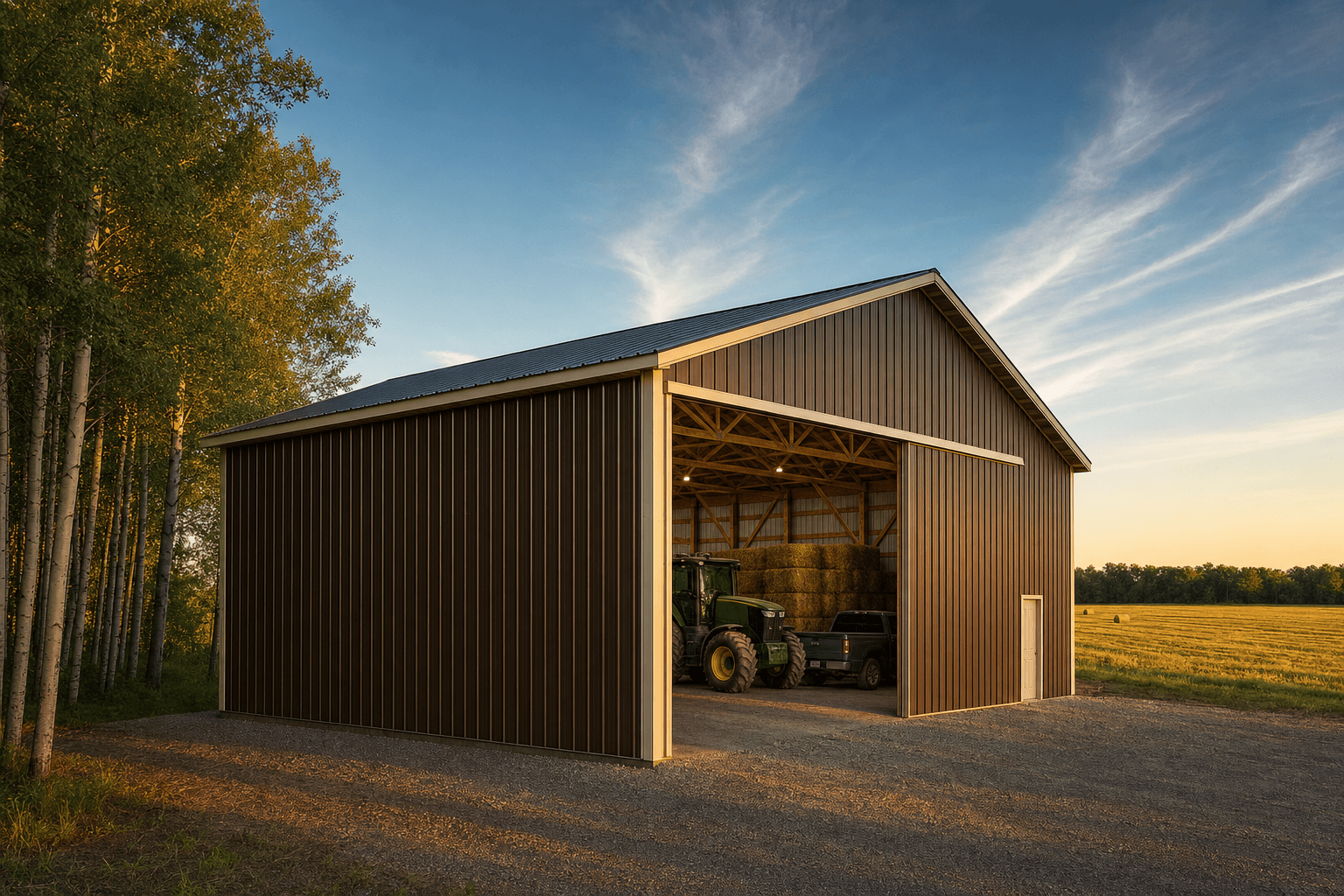
Hiring a pole barn builder in Minnesota is not the same as hiring one in Iowa, Indiana, or Texas. Frost depth, snow load, wind exposure, and county-by-county permitting all shift the math, and a builder who's never worked in our climate can produce a building that looks fine in October and starts telling on itself by the second February. Whether you're putting up a shop in Mora, a barndominium in Kanabec County, or a horse barn in Chisago, the checklist below will help you separate a builder you can trust with a six-figure project from one you can't.
Start with Minnesota-Specific Credentials
Any builder you talk to should be able to answer questions about Minnesota code and Minnesota conditions without flinching. If they can't, that's your first signal.
Minnesota contractor licensing
Residential pole barn builders working on dwellings in Minnesota must hold a Residential Building Contractor license issued by the Minnesota Department of Labor and Industry (DLI). Ag-only structures have narrower licensing requirements, but anyone building a barndominium, shop with living quarters, or any residence-bearing post-frame structure should be licensed. Ask for the license number and look it up on the DLI license lookup before you sign anything.
Insurance that actually covers your project
Two policies matter: general liability (protects against damage to your property or injuries to non-employees on site) and workers' compensation (protects you from being sued by an injured crew member). Ask for certificates of insurance naming you as the certificate holder, with coverage dates that span the build window. A reputable builder will email these without hesitation.
Vet Their Minnesota Construction Knowledge
Code requirements change with the climate. Here are the specific things a Minnesota pole barn builder should already know cold.
Frost depth and footing design
Minnesota Rule 1303.1600 sets minimum frost depth requirements that vary by county. Across most of our service area (Kanabec, Pine, Mille Lacs, Isanti, Chisago, Aitkin), footings need to be set at or below 60 inches to avoid frost heave. A builder who quotes you 42-inch or 48-inch footings without explaining why is either sloppy or out-of-state. Ask them what frost depth they use in your county and why.
Snow load and roof design
Most of central and east-central Minnesota sits in a ground snow load zone of 50 to 60 psf, with portions of the Arrowhead higher. Your builder needs to engineer the roof for the snow load that's actually on your site, not a regional average. Trusses sized for a 30-psf load (common in southern markets) will deflect, fail, or both under Minnesota snowfall.
Climate Zone 6A and 7 building practices
The 2020 Minnesota Residential Code (MNRC) bases insulation and air-sealing requirements on climate zones. Most of our service area is Zone 6A; northern counties brush into Zone 7. If you're building a barndominium, a shop with living quarters, or any conditioned space, the builder should be able to talk through R-value targets, vapor retarder placement, and continuous insulation strategies without reaching for a brochure.
Look at the Work, Not Just the Website
Pretty renderings are easy. Standing buildings are the proof. Before you sign, you should be able to walk at least two completed projects similar to yours.
- Ask for a project list within a 60-mile radius. Buildings in your weather are the only comps that count.
- Walk a 5-year-old build, not just a brand new one. New construction always looks great. A five-year-old building shows you how their work ages — fastener patterns, trim joints, paint adhesion, door seal condition.
- Ask the owner one question: would you hire them again? Listen for hesitation as much as the answer itself.
- Look at the small stuff. Tight trim returns, clean fastener lines, square corners, doors that close without a shove. These are tells.
Compare Quotes Apples-to-Apples
The single most common mistake homeowners make is choosing the lowest quote without confirming the quotes describe the same building. A pole barn quote is not one number — it's a stack of decisions, and a low quote often means a thinner stack.
What every quote should specify
- Post size, spacing, and embedment depth (or concrete pier system if applicable)
- Truss spacing, snow load rating, and wind load rating
- Roof and wall steel gauge, paint warranty length, and color
- Door and window specs by manufacturer and model, including overhead door insulation R-value
- Concrete: thickness, rebar or fiber mesh, vapor barrier, and whether floor is included
- Site work: who is responsible for grading, gravel base, and erosion control
- Permits: who pulls them and who pays the fees
If a quote doesn't itemize these, it's not a quote yet — it's a price tag. Ask the builder to break it out.
Understand Warranties and What They Actually Cover
Pole barn warranties have three layers, and they're often confused with each other.
- Manufacturer warranty on the steel (paint and substrate) — typically 40 years on the paint and longer on the panel itself
- Manufacturer warranty on doors, windows, and trusses — varies by supplier
- Builder workmanship warranty — the part most people forget to read. This is the builder standing behind their own labor: how long, what's covered, what's the dispute process. Minnesota law sets some minimum warranty periods for licensed residential builders (one year on workmanship and materials, two on plumbing, electrical, HVAC, and ten on structural). Anyone building a dwelling for you should know these numbers.
Communication and Project Management Tells
The way a builder handles your first three weeks of interactions is usually how they'll handle the build. Watch for the soft signals.
- How long between your first call and a real, scheduled site visit?
- Do they show up when they say they will? On time, with the information they promised?
- Are change orders documented in writing, with a price impact, before work happens?
- Who is your single point of contact during the build? Is it the salesperson, the project manager, or a crew lead?
A builder who is sloppy about communication before they have your money is going to be sloppier after.
Frequently Asked Questions
How far in advance should I start looking for a pole barn builder in Minnesota?
For a build you want completed in the same calendar year, start the builder conversation in the fall or winter before. Good Minnesota builders book out 6 to 9 months for spring and summer builds, and material lead times on doors and steel can run 8 to 14 weeks. Starting early gives you the leverage to choose, not just whoever is available.
Do I need an engineered drawing for a pole barn in Minnesota?
For most permitted structures over a certain footprint — and for any pole barn that will be used as a dwelling — yes. Your builder should be providing engineered truss drawings, foundation plans, and a building cross-section as part of the quote, and these should be stamped by a Minnesota-licensed engineer when required by your county.
Can a pole barn builder also do the concrete and site work?
Some can, some can't. Sherman handles the building, site prep coordination, and concrete on most of our projects so the homeowner only deals with one company. If your builder subs everything out, ask who's responsible if the concrete cures wrong or the grading is off after rain — and ask in writing.
What is the difference between a pole barn and a post-frame building?
Post-frame is the engineering term. Pole barn is the historical term. Modern post-frame construction uses laminated columns or treated timbers set into the ground or onto engineered brackets, with trusses spanning between them. Same family of building, different generation of name.
How do I know if a builder will actually still be in business in five years?
Look at how long they've been local, how many crews they run, and whether they own their shop and yard. Builders with a fixed Minnesota address, multi-generation ownership, and visible community presence are far less likely to disappear when you call about a warranty claim in year four.
What should I ask a pole barn builder before signing a contract?
Ask what ground snow load and wind speed the building is engineered to, and whether the trusses are engineered for your specific site or pulled from stock. Ask what footing depth they're using and whether it matches the frost zone for your county, which is 60 inches in Zone I and 42 inches in Zone II under Minnesota Rules 1303.1600. Ask who pulls the permits and who owns the inspection schedule. Ask whether the quote includes site prep, concrete, and utility rough-ins or whether those are separate. Sherman Buildings answers all of these in writing before a contract, engineers to the 2020 Minnesota State Building Code, and holds Minnesota license BC004619.
Why Homeowners in Our Region Call Sherman
Sherman Buildings has been putting up pole barns, barndominiums, shops, and ag structures across central and east-central Minnesota — Kanabec, Pine, Mille Lacs, Isanti, Chisago, and Aitkin counties — from our home base in Mora. We design every build for Minnesota frost depth and snow load, we walk you through quotes line by line so you can compare them honestly, and we'd rather talk you out of the wrong building than sell you one. If you're collecting bids and you want to know what a fair, Minnesota-grounded quote looks like, give us a holler. No pressure, no contracts at the kitchen table — just a conversation about what you're trying to build.